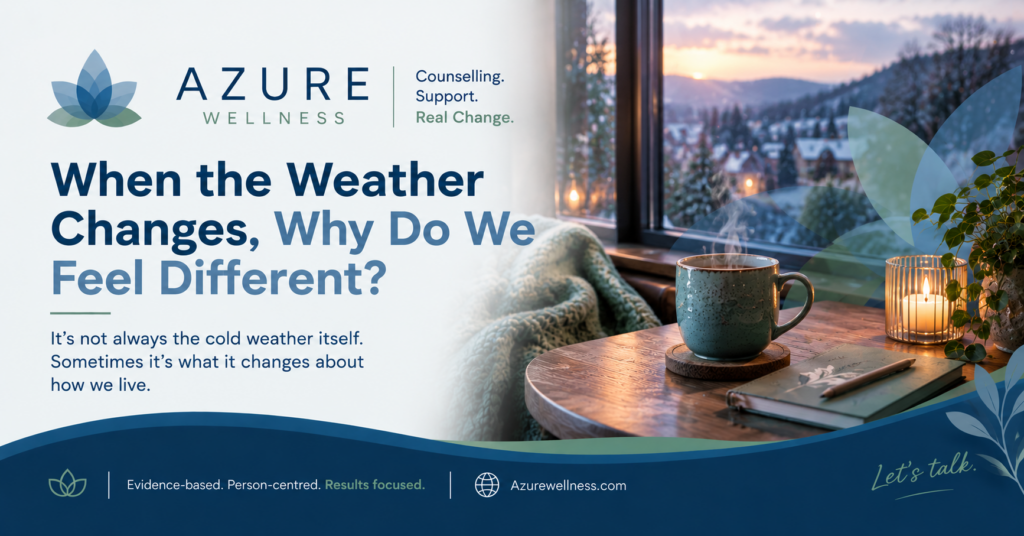
Have you ever noticed that your mood seems to change when the weather does?
Maybe you feel more sluggish when it’s cold and dark outside. Perhaps you find yourself staying indoors more, cancelling plans or spending longer in bed at the weekend.
Or maybe you’ve simply noticed that you don’t feel quite like yourself.
It’s easy to blame the weather.
“It’s just winter.”
“I’m tired because it’s dark.”
“I just can’t be bothered today.”
But there can be more going on than that.
It’s not always the weather
Cold weather changes more than the temperature.
It can change what we do.
We might stop going for our usual evening walk because it’s dark. We might spend more time indoors. We might see friends less often because getting out feels like more effort.
Even small changes can add up.
Think about what a summer evening might look like. You finish work, the sun is still out, you might go for a walk, sit outside, meet someone for a coffee or simply spend some time in the garden.
In winter, that same evening can look very different.
You finish work.
It’s dark.
It’s cold.
You get home.
And suddenly the sofa seems like the only reasonable place to be.
There’s nothing wrong with wanting a quiet evening. Sometimes we genuinely need one.
But if that becomes the pattern every day, we can gradually lose some of the things that help us feel well without even noticing.
Our environment affects us
We often think of mental wellbeing as something that happens entirely inside our heads.
But we’re also influenced by what is happening around us.
Our routines.
Our surroundings.
The amount of daylight we experience.
How much we’re moving.
How often we’re seeing people.
Whether we have things to look forward to.
None of these things determine how we feel, but they can all play a part.
This is one reason the darker months can feel particularly difficult for some people.
For some, the change in season brings a noticeable drop in mood and energy. Seasonal Affective Disorder, commonly known as SAD, is a form of depression that follows a seasonal pattern.
That doesn’t mean that every winter slump is SAD.
Sometimes you’re simply tired.
Sometimes life is stressful.
Sometimes you’ve been running on empty for months and the darker evenings give you fewer opportunities to recharge.
The important thing is to notice the pattern rather than immediately judging yourself.
What has changed?
This might be a useful question to ask when you’re feeling different.
Not:
“What’s wrong with me?”
But:
“What’s changed?”
Have you stopped doing something you normally enjoy?
Are you spending less time outside?
Are you seeing people less?
Has your sleep changed?
Are you getting enough daylight?
Have you gradually filled your evenings with scrolling because you don’t have the energy to do anything else?
Sometimes identifying the change is the first step towards changing how you feel.
And it doesn’t have to mean completely redesigning your life.
You don’t need to fight winter
There’s a temptation to think we should somehow maintain our summer selves all year round.
Same energy.
Same motivation.
Same social life.
Same productivity.
But perhaps that’s not realistic.
Winter naturally encourages us to slow down.
The problem isn’t slowing down.
The problem is when slowing down becomes withdrawing from everything that usually helps us feel connected and alive.
There is a difference between resting and retreating.
Rest gives something back to you.
Retreating can sometimes leave you feeling more disconnected.
So perhaps the goal isn’t to force yourself to be constantly active throughout the colder months.
It’s to be intentional about the things you keep.
Keep the walk, even if it’s shorter.
Keep seeing the friend, even if you don’t stay out as long.
Keep making things.
Keep going somewhere that makes you feel good.
Keep finding little reasons to leave the house.
You don’t need to love the cold weather.
You just need to make sure it doesn’t quietly shrink your world.
Creativity can help us notice what we need
This is where creativity can offer something a little different.
You don’t have to be artistic.
You don’t need expensive materials or a particular skill.
Sometimes sitting down with a pen and allowing yourself to make marks on a page can create enough space to notice what’s going on inside.
You might draw your current environment.
Then draw somewhere you’d rather be.
Maybe your picture is full of colour.
Maybe it’s completely abstract.
Maybe it’s just a few lines.
There isn’t a right answer.
The interesting part is noticing what you create.
What colours did you reach for?
What did you put into the picture?
What did you leave out?
What kind of environment did your mind create when you weren’t worrying about making it “good”?
Sometimes our creativity can tell us things before we’ve found the words ourselves.
The Azure Pause
Find a window in your home and spend a few minutes looking outside.
Then, rather than drawing what you can see, draw what you’d like to see.
It could be a beach, a forest, a city you’ve visited, a completely imaginary landscape or simply a brighter version of the view in front of you.
Don’t worry about whether you can draw.
Let the picture be whatever it needs to be.
When you’re finished, ask yourself:
“What is it about this place that I needed today?”
Maybe it’s warmth.
Space.
Adventure.
Quiet.
Connection.
Freedom.
You don’t necessarily need to recreate the picture in real life.
But it might give you a clue about something your mind is asking for.
The colder months don’t have to become a season where you simply wait for spring.
There can still be connection, creativity, movement, laughter and things to look forward to.
And if you’ve noticed that the change in season is having a bigger impact on your mood, energy or everyday life, you don’t have to simply put it down to the weather and push through.
At Azure Wellness, counselling provides a safe and supportive space to explore what you’re experiencing and understand what might be sitting underneath it.
If this blog resonated with you, get in touch to find out more about counselling at Azure Wellness.