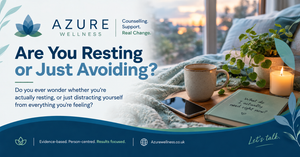
You finally get home.
You get changed, make yourself comfortable and pick up your phone.
You scroll for a bit.
Then a bit more.
You watch something. Check your messages. Scroll again.
Before you know it, two hours have passed.
Technically, you haven’t done anything.
But do you actually feel rested?
Sometimes the answer is yes.
Sometimes it’s not.
And that difference is worth noticing.
Not everything that feels like rest actually restores us
There’s nothing wrong with watching television after a long day.
There’s nothing wrong with scrolling through your phone, playing a game or disappearing into a film for a few hours.
Sometimes distraction is exactly what we need.
We don’t need to turn every moment of downtime into something productive.
But there is a difference between choosing to switch off and using something to avoid switching off.
You might recognise the feeling.
You finally have some quiet time, but instead of enjoying it, you immediately reach for your phone.
You feel restless when there’s nothing to do.
You keep something playing in the background because silence feels uncomfortable.
You stay busy because stopping gives you too much time to think.
The activity itself isn’t necessarily the problem.
It’s what you’re using it for.
What are you trying not to think about?
Sometimes being constantly occupied is easier than being alone with your thoughts.
If you’re worried about something, keeping busy can give you temporary relief.
If you’re upset, scrolling can provide somewhere else to put your attention.
If you’re lonely, watching other people’s lives online can create the feeling of connection without requiring any vulnerability.
And if you’re exhausted, doing absolutely nothing might seem like the easiest option.
There’s nothing wrong with any of that.
The problem comes when distraction becomes the only way you know how to cope.
Because eventually the phone gets put down.
The programme ends.
The house becomes quiet.
And whatever you were trying not to think about is still there.
Rest should give something back to you
This doesn’t mean every form of rest needs to leave you feeling energised.
Sometimes good rest is simply doing nothing.
But there is value in asking yourself how different activities actually make you feel afterwards.
Think about the difference between spending an hour scrolling through social media and spending an hour doing something you genuinely enjoy.
Maybe you finish scrolling feeling tired, distracted and slightly irritated.
Maybe you finish painting feeling calmer.
Maybe you finish a walk feeling clearer.
Maybe you finish talking to a friend feeling more connected.
None of these activities are inherently good or bad.
The question is:
How do I feel afterwards?
That’s often more useful than asking whether something counts as “self-care.”
Sometimes avoidance looks productive
Avoidance doesn’t always look like lying on the sofa.
Sometimes it looks like doing everything except the thing that’s bothering you.
You clean the kitchen.
Organise your wardrobe.
Answer emails.
Start another project.
Find something that needs doing.
And suddenly you’ve had a very productive day without touching the thing you actually needed to deal with.
Again, this isn’t about criticising yourself.
There are times when cleaning the kitchen is genuinely just cleaning the kitchen.
But if you notice yourself repeatedly becoming incredibly busy whenever something difficult comes up, it might be worth getting curious about that.
What happens when I stop?
That’s often the more interesting question.
You don’t need to turn rest into another task
There’s a danger here too.
We could take the idea of “rest properly” and turn it into another thing we’re supposed to get right.
Suddenly we’re worrying about whether we’re resting correctly.
That’s not the point.
You don’t need to replace your phone with a candle, a yoga mat and a perfectly organised evening routine.
You don’t need to meditate for twenty minutes.
You don’t need to read a book every night.
You don’t need to become someone who wakes up at 5am and journals before sunrise.
Sometimes you just need to watch something rubbish on television and enjoy it.
The difference is choice.
If you choose it because you genuinely want to, that’s different from automatically reaching for it because you don’t want to be alone with your thoughts.
What if you allowed yourself to notice?
The next time you find yourself reaching for your phone at the end of a difficult day, pause for a moment.
Not to stop yourself.
Just pause.
Ask:
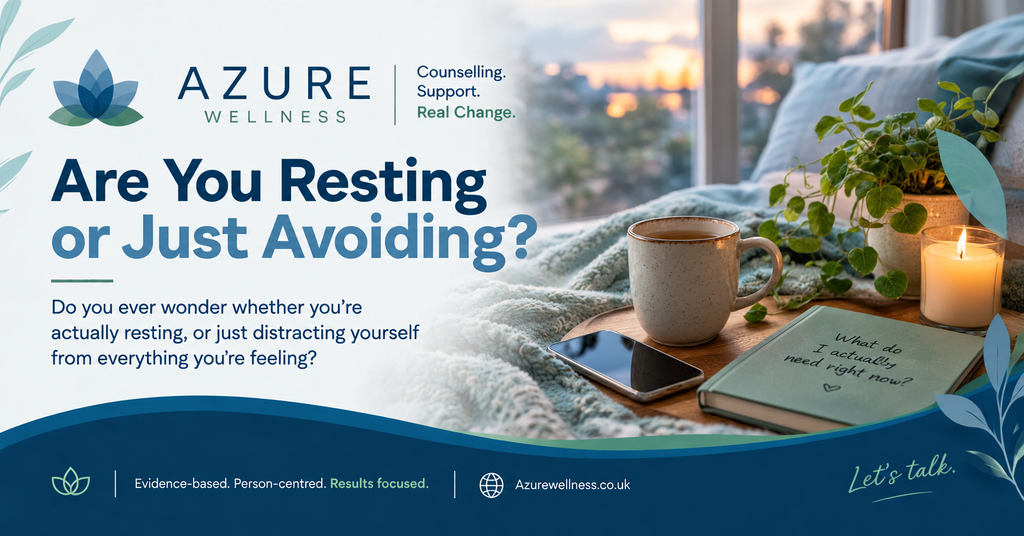
What do I actually need right now?
Maybe the answer is distraction.
That’s okay.
Maybe you need connection.
Maybe you need sleep.
Maybe you need to cry.
Maybe you need to make something.
Maybe you don’t know.
You don’t have to immediately solve the answer.
Sometimes simply noticing is enough.
The Azure Pause
Take a piece of paper and draw a line down the middle.
On one side write:
Things that help me switch off
On the other:
Things that help me feel better afterwards
Then fill it in honestly.
You might find that some things appear on both sides.
Others might only appear in the first column.
That’s not a failure.
It’s information.
You might discover that scrolling helps you switch off but doesn’t necessarily leave you feeling better.
You might realise that drawing, walking, listening to music or talking to someone rarely feels appealing beforehand but usually leaves you feeling lighter afterwards.
There’s no right answer.
The aim isn’t to create a perfect list of things you should be doing.
It’s simply to understand yourself a little better.
Because sometimes the thing we think we need isn’t actually rest.
It’s relief.
And those aren’t always the same thing.
If you find yourself constantly distracting yourself from thoughts, feelings or situations that are becoming difficult to manage, you don’t have to keep doing it alone.
At Azure Wellness, counselling offers a safe space to slow things down and explore what might be underneath the things you’re finding difficult to sit with.
You don’t need to have everything figured out before you reach out.
If this blog resonated with you, get in touch to find out more about counselling at Azure Wellness.