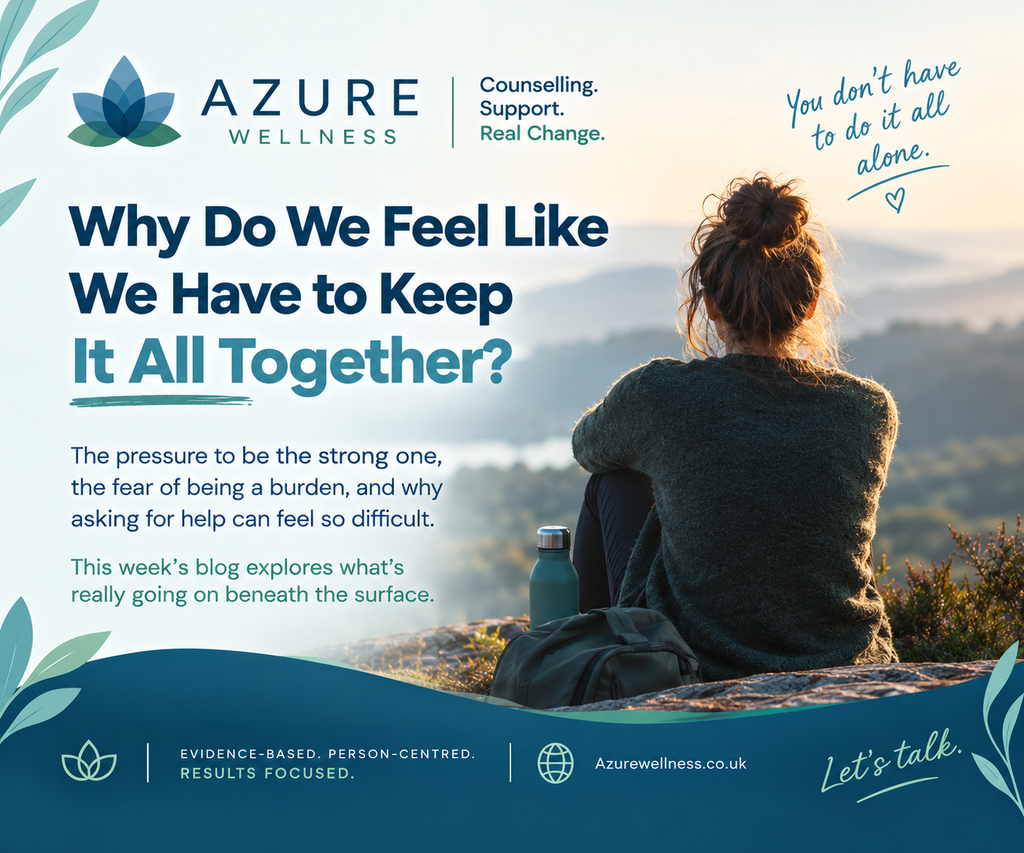
Sometimes, the hardest part of struggling is making sure nobody notices.
You get up, get dressed, go to work, answer messages and do all the things you’re supposed to do. You smile when someone asks how you are. You say you’re tired when you’re actually overwhelmed. You tell people you’re fine because explaining the truth feels like more effort than you have left.
And then you carry on.
Maybe you’ve become the person everyone relies on. The one who sorts things out, keeps everyone calm, listens to other people’s problems and somehow manages to get everything done.
But when was the last time you let someone see that you were struggling too?
When being strong becomes an expectation
There’s nothing wrong with being capable. Being dependable can be a wonderful quality, and there are times in life when we need to dig deep and keep going.
But sometimes, without really noticing, we start to believe that being strong means never letting anyone see us struggle.
We become uncomfortable asking for help. We downplay our feelings. We tell ourselves that other people have it worse, so we shouldn’t complain.
We might even feel guilty for finding things difficult when, from the outside, our lives look perfectly fine.
Over time, being the person who keeps everything together can become more than something we do. It can become the role we feel we have to play.
And when everyone expects us to be that person, admitting we’re struggling can feel strangely difficult.
The problem with always saying “I’m fine”
Think about the last time someone asked how you were doing.
Did you tell them the truth?
Not necessarily every detail of your life, but an honest answer about how you were feeling.
Or did you automatically say, “I’m fine, thanks”?
Most of us have done it. Sometimes it’s simply a polite response. We don’t always want to have a deep conversation in the supermarket or explain our lives to a colleague in the corridor.
But sometimes, “I’m fine” becomes our default answer even when we’re talking to people we trust.
We say it because we don’t want to worry anyone. Because we don’t know how to explain what’s going on. Because we’re afraid of being a burden. Or because we’ve spent so long keeping our feelings to ourselves that we’ve lost the habit of sharing them.
The longer this goes on, the easier it becomes for people to assume we’re coping.
And the harder it can feel to tell them otherwise.
Sometimes, people don’t realise how much we’re struggling because we’ve become very good at hiding it.
That doesn’t mean it’s your fault. It means the version of you that other people see might not tell the whole story.
You can be struggling and still be functioning
One of the reasons we sometimes dismiss our own difficulties is that we’re still managing to get things done.
We’re going to work. We’re paying the bills. We’re looking after the children. We’re showing up for our friends. We’re doing what needs to be done.
So we tell ourselves that we can’t really be struggling.
But functioning and feeling okay aren’t the same thing.
You can be meeting every responsibility while feeling completely exhausted inside. You can support everyone around you while feeling as though nobody is supporting you. You can laugh, make plans and appear perfectly happy while carrying worries that you haven’t shared with anyone.
Being able to keep going doesn’t automatically mean that things are manageable.
Sometimes it simply means you’ve found a way to keep going despite how difficult things feel.
And while that ability might help you get through a challenging period, it can become exhausting when you feel you have to maintain it indefinitely.
Why asking for help can feel so uncomfortable
You might think that if someone is struggling, they should simply tell someone.
But it’s rarely that straightforward.
For some people, asking for help means admitting that they can’t manage everything themselves. For others, it brings up fears of being judged, misunderstood or treated differently.
Perhaps you’ve learnt from past experiences that people don’t always respond well when you open up. Maybe you’ve been told to toughen up, stop worrying or look on the bright side.
Perhaps you’ve become so used to being the person who helps others that you don’t know how to be on the receiving end.
Or maybe you don’t want to add anything else to anyone else’s plate.
Whatever the reason, keeping things to yourself can begin to feel safer than risking a conversation that might leave you feeling exposed.
But there’s a difference between choosing what you share and feeling that you’re not allowed to share anything at all.
You don’t owe everyone access to your private life. You don’t have to explain yourself to people you don’t trust.
However, if you’re constantly hiding your struggles from the people who genuinely care about you, it might be worth asking yourself what you’re protecting yourself from, and what it’s costing you to keep everything inside.
Being strong doesn’t mean doing everything alone
We often talk about strength as though it means being able to withstand anything.
Keep going. Push through. Don’t give up. Stay positive.
But there’s another side to strength that doesn’t get talked about quite as much.
The strength it takes to admit you’re struggling.
To say, “I’m not doing as well as I thought I was.”
To tell someone you need a hand.
To acknowledge that something is affecting you, even when you can’t immediately fix it.
These things can feel uncomfortable, particularly if you’re used to being independent or looking after everyone else.
But allowing yourself to be supported doesn’t take away from your strength. It recognises that you’re a person with needs of your own.
You can be capable and still need help. You can be resilient and still feel overwhelmed. You can be the person others rely on and still deserve somewhere to put down what you’re carrying.
You don’t have to reach breaking point before your struggles deserve attention.
You don’t need to prove that things are bad enough. You don’t need to wait until you can’t cope anymore.
It’s okay to ask for support simply because things feel difficult right now.
What if you stopped pretending, just a little?
This doesn’t mean you need to suddenly tell everyone how you’re feeling or make yourself vulnerable before you’re ready.
Sometimes, a small change is enough.
Instead of automatically saying you’re fine to someone you trust, you could say, “It’s been a bit of a difficult week, actually.”
Instead of agreeing to help when you’re already overwhelmed, you could say, “I’d like to help, but I haven’t got the capacity at the moment.”
Instead of dismissing your feelings because someone else has it worse, you could acknowledge that your experience matters too.
These might seem like small things, but they allow a little more honesty into your relationships.
They also give other people the opportunity to understand you better, rather than expecting them to notice what you’ve worked so hard to hide.
And if opening up feels too difficult right now, you can start by being honest with yourself.
You don’t have to have the answers. You don’t have to know exactly what you need. You can simply acknowledge that things are harder than you’ve been letting on.
Sometimes, that’s where change begins.
The Azure Pause: What Am I Carrying?
Find a piece of paper and draw the outline of a bag, a box or even a person.
Inside it, write or draw the things you feel you’re carrying at the moment.
Perhaps it’s responsibility, worry, family expectations, work pressure, guilt, grief or the feeling that you always have to be the strong one.
Don’t worry about making it neat or explaining everything perfectly. This is just a way to give some space to things that might usually stay in your head.
Then, around the outside, write down what other people might see when they look at you.
Perhaps they see someone dependable, cheerful, calm, organised or capable.
Take a moment to compare the two.
What are you carrying that other people might not realise is there?
You might also ask yourself whether there’s anything in that picture you’d like someone to understand, or something you no longer want to carry entirely on your own.
You don’t have to act on anything straight away. Simply noticing the difference between what you show the world and what you experience privately can tell you something important.
You deserve support too
If you’re always the person who keeps things together, it can be difficult to recognise when you need support yourself.
You might have become so accustomed to putting other people first that your own needs feel unfamiliar, inconvenient or even selfish.
But you matter in those relationships too.
You deserve to be listened to. You deserve space to work through difficult feelings. And you deserve relationships where you don’t always have to be the one who is okay.
You don’t have to stop being dependable, capable or strong. You don’t have to change your personality or become someone who shares everything with everyone.
Perhaps the goal is simply to make a little more room for the parts of you that struggle, feel uncertain or need a hand sometimes.
Because keeping everything together isn’t always the same as being okay.
And you shouldn’t have to carry everything alone just to prove that you can.
If this resonates with you, counselling can offer a space where you don’t have to look after anyone else, pretend you’re fine or have everything figured out. At Azure Wellness, you can explore what’s been weighing on you in a warm, supportive and non-judgemental environment.
If you’d like to find out more, you’re welcome to get in touch to discuss whether counselling might be right for you.