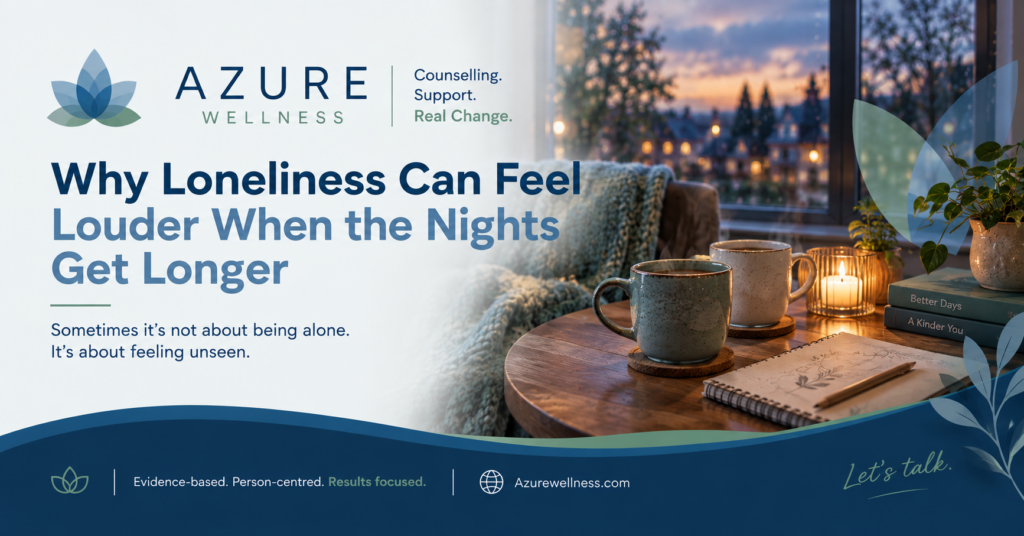
There is a particular kind of loneliness that can be difficult to explain.
You can have people around you. You can go to work, answer messages, spend time with family and still feel strangely disconnected.
Sometimes you don’t even realise you’re lonely until things become quiet.
The evenings get darker. The weather changes. You spend more time at home. Plans become less frequent.
And suddenly, feelings that were easy to ignore when life was busy become much harder to avoid.
Being alone isn’t always the same as feeling lonely
There is a difference between choosing to be alone and feeling alone.
Being alone can be peaceful. It can give you space to think, recharge and do things at your own pace.
Loneliness is different.
Loneliness is often about connection rather than the number of people around you.
You might have hundreds of contacts in your phone but nobody you feel you can call when you’re struggling.
You might sit around a dinner table with your family but feel unable to say what’s really going on.
You might laugh with friends and still go home feeling like nobody really knows you.
That can be a difficult feeling to put into words.
Why does loneliness seem louder at this time of year?
As the evenings become darker and the days feel shorter, our routines can change.
We may spend less time outside. We may see people less often. We might come home from work and stay there for the rest of the evening.
For some people, this is exactly what they need.
For others, the quieter months can make disconnection more noticeable.
Summer can naturally create opportunities for connection. Longer evenings, holidays, outdoor activities and spontaneous plans can make it easier to see people.
Then autumn arrives.
Life becomes more routine.
And sometimes we don’t realise how much connection we were getting until it starts to disappear.
Sometimes we get used to being disconnected
This is the part that can catch us out.
When we’re busy, we can convince ourselves that we simply don’t have time for people.
I’ll message them later.
We’ll arrange something next week.
Once work settles down, I’ll make more effort.
Then weeks pass.
The distance becomes normal.
And reaching out can start to feel strangely difficult.
You might worry that you’ve left it too long.
You might wonder whether they’ll want to hear from you.
You might even convince yourself that they’re busy and don’t have time for you.
So you don’t ask.
This is where loneliness can become a cycle.
We want connection, but we’re afraid to reach for it.
What kind of connection are you actually missing?
It can be useful to ask yourself this honestly.
Are you missing company?
Are you missing affection?
Are you missing someone who understands you?
Are you missing having something to look forward to?
Or are you missing a version of yourself that seemed to exist when you felt more connected?
These aren’t necessarily the same thing.
Sometimes what we need isn’t more social activity.
It’s more meaningful connection.
One honest conversation can sometimes feel more nourishing than an entire evening surrounded by people.
And that doesn’t mean you need to suddenly become more social.
It might simply mean finding one person you feel comfortable with and saying:
“I haven’t been feeling quite myself lately.”
You don’t need to explain everything.
You don’t need to have the perfect words.
You can simply open the door.
Don’t underestimate small moments of connection
Connection doesn’t always have to mean going out or making big plans.
It could be sending someone a voice note instead of a message.
Having a coffee with a friend.
Checking in on a neighbour.
Walking somewhere with someone rather than alone.
Sitting beside someone without needing to fill the silence.
Even making something can become a form of connection.
Cooking for someone.
Painting alongside a friend.
Doing a jigsaw together.
Sharing something you’ve created.
Creativity can give us another way of communicating, particularly when talking about feelings feels difficult.
You don’t have to know exactly what you’re trying to express.
Sometimes the process itself can help you understand what you’re feeling.
And sometimes you need more than a distraction
It’s important to recognise that loneliness isn’t always something we can solve by simply making more plans.
If you’ve been feeling disconnected for a long time, it may be connected to grief, anxiety, low self-esteem, relationship difficulties or other experiences that deserve some attention.
Sometimes the hardest part isn’t finding people.
It’s feeling safe enough to let people in.
That is something worth exploring rather than blaming yourself for.
You aren’t weak because you want connection.
You aren’t needy because you want to feel understood.
And you haven’t failed because you’re finding this time of year difficult.
Human beings need connection.
That’s not a flaw to overcome.
It’s part of being human.
The Azure Pause
Take a piece of paper and draw three circles.
In the first, write the names of people who energise you.
In the second, write the names of people you feel safe with.
In the third, write the names of people you would like to reconnect with.
Don’t turn it into another task to complete.
Just notice what you see.
Maybe there’s someone you’ve been meaning to contact.
Maybe you’ve realised that you’re surrounded by people but still don’t feel particularly understood.
Or perhaps you’ve noticed that there is more connection in your life than you thought.
Whatever you discover, let it be information rather than a judgement.
And if there is someone you thought of while doing this, perhaps send them a simple message.
It doesn’t need to be complicated.
“I’ve been thinking about you. How are you?”
Sometimes connection begins with something that simple.