There comes a point every year when you realise summer has properly gone.
The mornings are darker.
The evenings seem to arrive almost as soon as the working day has finished.
You might find yourself reaching for another coffee, cancelling plans you would normally have made, or feeling like even the simplest things require a little more effort.
And then comes the guilt.
Why am I so tired?
Why can’t I be bothered?
Why am I not getting as much done?
We can be surprisingly hard on ourselves when our energy changes.
We’re expected to keep going at the same pace regardless of what’s happening around us. Work doesn’t necessarily slow down because the evenings are darker. The washing still needs doing. The children still need picking up. Messages still need answering.
But we aren’t machines.
Our environment affects us.
Light, sleep, routine, temperature, activity and social connection can all influence how we feel. So when the seasons change, it’s not unusual to notice changes in your energy or mood too.
That doesn’t mean every low-energy day is seasonal depression, and it’s important not to assume that it is. But for some people, the change in season can have a much more significant impact on their mental health. Seasonal Affective Disorder, often referred to as SAD, is a form of depression where symptoms follow a seasonal pattern.
The important thing is noticing what is happening for you.
Maybe you’re simply adjusting to autumn.
Maybe you’ve been pushing yourself too hard for months and the change in pace is making you realise how tired you actually are.
Or perhaps you’ve noticed a recurring pattern where your mood drops significantly as the darker months arrive.
There is a difference between noticing something and judging yourself for it.
Instead of thinking, “What’s wrong with me?” try asking, “What has changed?”
That’s a much more useful question.
Has your routine changed?
Are you getting outside less?
Are you sleeping differently?
Have you stopped seeing people because it’s easier to stay home?
Are you expecting yourself to function at exactly the same level you did during the lighter months?
Sometimes the answer isn’t to push harder.
Sometimes it’s to listen.
That might mean getting outside while there’s still daylight, even if it’s only for a short walk.
It might mean making plans with someone rather than waiting until you feel like socialising.
It might mean accepting that some evenings are better suited to a quiet night at home than another thing on your calendar.
And it might mean finding small things that give you a sense of enjoyment.
This is where creativity can be surprisingly useful.
You don’t need to suddenly become an artist.
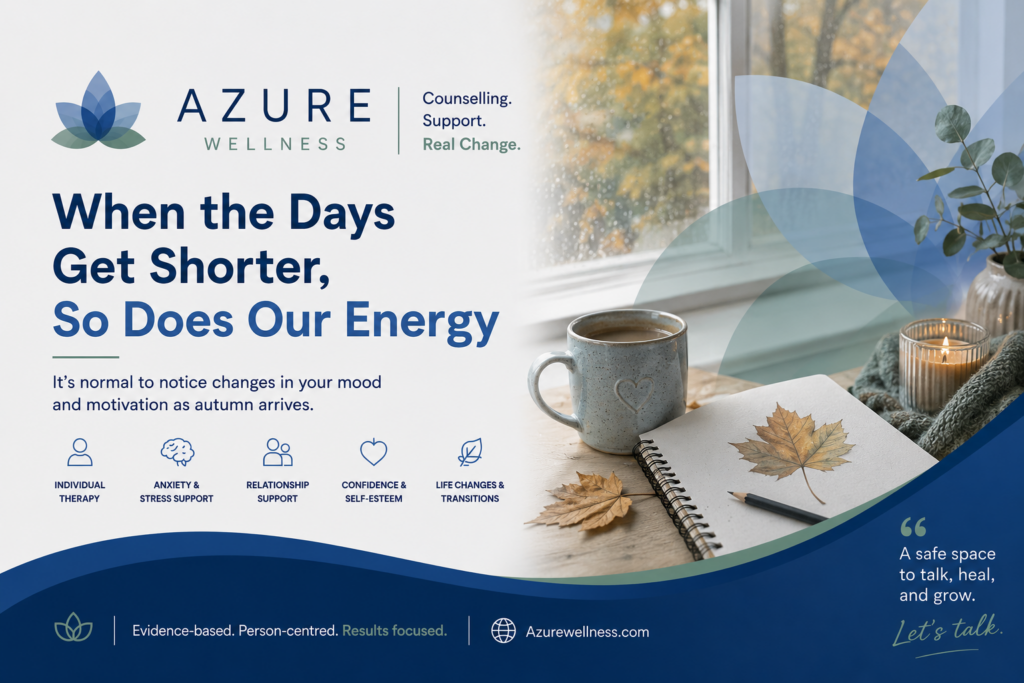
You could sit with a cup of tea and sketch something you can see from your window. You could take photographs on an autumn walk. You could collect leaves and make a simple collage. You could put some music on and paint whatever comes to mind.
The point isn’t the finished product.
It’s the experience of doing something that isn’t about productivity.
Something that gives your mind somewhere else to go.
We spend so much of our lives measuring ourselves by what we’ve achieved that we can forget there is value in simply experiencing something.
A walk doesn’t have to count as exercise.
A drawing doesn’t have to be good.
An evening doesn’t have to be productive.
You don’t have to squeeze every last drop of usefulness out of your day.
Perhaps autumn is a good reminder of that.
The trees don’t panic when their leaves begin to fall.
They don’t try to stay in summer.
They change.
Slowly.
Naturally.
And perhaps we can give ourselves permission to do the same.
If you’re feeling a little slower as the days get shorter, try not to immediately turn that feeling into a criticism of yourself.
Pay attention to it.
Be curious about it.
And if the change in your mood or energy is persistent, significant or beginning to affect your everyday life, it may be worth talking to someone rather than simply trying to push through it.
You don’t have to wait until things become unbearable before you ask for support.
The Azure Pause
Next time you’re outside during daylight, take ten minutes without your phone.
Notice three things you can see, three things you can hear and three things you can feel.
When you get home, choose one thing you noticed and sketch it in a notebook.
It doesn’t matter what it looks like.
The aim isn’t to create something beautiful. It’s simply to slow down enough to notice where you are.
Sometimes that’s where we find a little more breathing space.
If you’ve noticed that the change in seasons is affecting your mood, energy or motivation, you don’t have to figure it out on your own.
At Azure Wellness, counselling offers a safe space to explore what you’re experiencing, understand the patterns behind it and work towards changes that feel manageable for you.
If this blog resonated with you, feel free to get in touch to find out more.